
When an Athletic Trainer applies to your job, their Go4 profile gives you important information to help you make a confident and informed hiring decision.
Beginning September 1, 2026, Job Posters will see a redesigned Athletic Trainer applicant profile that provides greater visibility into:
- Reliability Score and score trends
- Lifetime work history
- Previous experience with your organization
- Recent Go4 activity
- Callouts and no-shows
- Positive reliability behaviors
- Sports and setting experience
- Verified credentials
The goal is to provide greater transparency into who you're hiring while giving Athletic Trainers the opportunity to be evaluated based on both their professional experience and how they've recently participated in the Go4 marketplace.
Better Information. Better Hiring Decisions.
Reliability is only one part of an Athletic Trainer's profile. Review their Reliability Score alongside recent activity, experience, credentials, and your organization's previous experience with them when making hiring decisions.
New Beginning September 1, 2026
Athletic Trainers have had visibility into the updated Reliability Score and scoring system since July 2026, giving them time to understand how their marketplace activity impacts their score before scores became visible to Job Posters.
Beginning September 1, Job Posters can now see this information when reviewing applicants. The score you see on September 1 is not starting from scratch—it already reflects qualifying Athletic Trainer activity from the previous three months.
Going forward, the Reliability Score will continue to reflect qualifying activity within the rolling six-month scoring window.
Understanding the Reliability Score
An Athletic Trainer's Reliability Score provides insight into how reliably they've fulfilled their commitments and participated in the Go4 marketplace.
Scores are measured against a perfect score of 1,000.
New Athletic Trainers begin with a Reliability Score of 750. This provides every new Athletic Trainer with a fair starting point in the marketplace before they've had the opportunity to establish a work history on Go4.
From there, their score can increase or decrease based on qualifying positive and negative marketplace activity. As Athletic Trainers successfully complete shifts, reach reliability milestones, pick up coverage, or experience reliability events such as callouts or no-shows, their score can change accordingly.
Alongside the numerical score, you'll see a reliability rating and a graph showing how the Athletic Trainer's score has changed over time. You'll also see how many points their score has gained or lost over the displayed period.
This allows you to evaluate more than an Athletic Trainer's current score—you can also understand how they got there and the direction their reliability is trending.
New to Go4 Doesn't Mean Unreliable
Every new Athletic Trainer starts with 750 points. A starting score of 750 does not indicate negative activity—it simply means the Athletic Trainer is new to the Go4 marketplace and has not yet had the opportunity to build their Reliability Score through marketplace activity.
Don't Look at the Number Alone
A Reliability Score is most useful when viewed alongside the activity behind it. Review the Athletic Trainer's Recent Go4 Activity, work history, experience, and credentials to get the full picture before making a hiring decision.
Recent Behavior Matters More Than Old Behavior
The previous reliability experience relied heavily on lifetime behavior, comparing historical callouts against an Athletic Trainer's all-time shifts worked.
The updated Reliability Score takes a different approach.
Negative Reliability Score activity only impacts an Athletic Trainer's score for six months from the date of the incident.
Why?
Because someone who experienced a no-show or callout years ago shouldn't necessarily be evaluated today as though it just happened. Circumstances can change, and so can behavior.
After six months, the penalty associated with negative activity expires and no longer negatively impacts the Athletic Trainer's current Reliability Score.
Historical information may still be available for transparency, but it doesn't continue negatively affecting their score indefinitely.
A Rolling Six-Month View
Reliability should reflect how an Athletic Trainer is participating in the marketplace today. Negative score activity ages out after six months, giving Athletic Trainers an opportunity to demonstrate improved reliability over time.
Reliability Isn't Just About Penalities
The updated Reliability Score isn't designed to only penalize Athletic Trainers when something goes wrong. It's also designed to encourage behaviors that help create a stronger, more reliable marketplace.
The positive point opportunities within the Reliability Score were intentionally built around behaviors that benefit Job Posters, based on feedback we've received from organizations using Go4.
One of the biggest concerns we hear from Job Posters is what happens when coverage is still open—especially when an Athletic Trainer calls out close to an upcoming shift. Suddenly, an organization that thought it had coverage is back to searching for an Athletic Trainer with limited time.
That's why Athletic Trainers can earn Reliability Score points for behaviors such as picking up coverage on shorter notice.
An Athletic Trainer who steps in to cover an open shift can:
- Earn positive points toward their Reliability Score
- Earn additional income by picking up the shift
- Help an organization secure the Athletic Trainer coverage it needs
It's a win for both sides of the marketplace: Athletic Trainers have an additional incentive to help fill important coverage gaps, while Job Posters have a stronger network of Athletic Trainers motivated to step in when coverage is needed most.
Positive points can also be earned through consistent reliability. For example, Athletic Trainers can reach consecutive shift milestones by continuing to work their confirmed shifts without callouts or no-shows.
Rewarding Behaviors That Strengthen the Marketplace
Positive Reliability Score actions aren't arbitrary. They're designed to encourage behaviors that Job Posters have told us matter—honoring commitments, consistently showing up, and helping fill coverage when organizations need it most.
Why This Matters
Reliability works best when it creates accountability and encourages better outcomes.
Rather than only reducing a score when an Athletic Trainer has a callout or no-show, the updated system gives Athletic Trainers a path to actively build their reliability through behaviors that benefit the organizations hiring them.
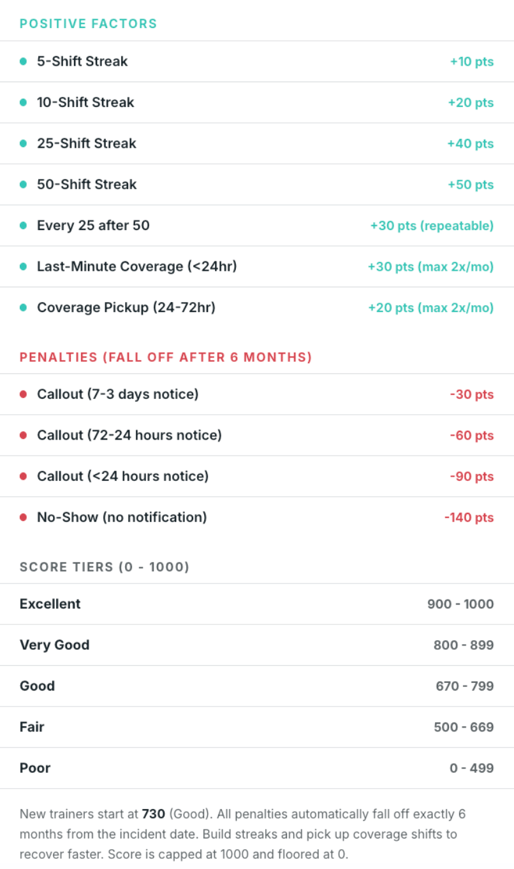
How Reliability Score Point Works
An Athletic Trainer's Reliability Score can increase or decrease based on qualifying marketplace activity.
Positive points are designed to reward behaviors that strengthen the marketplace—such as consistently honoring shift commitments or helping organizations secure coverage on shorter notice.
Negative points reflect reliability events such as callouts and no-shows, with the scoring system taking the circumstances and timing of those events into consideration.
Remember: Points Don't Last Forever
Negative Reliability Score activity impacts an Athletic Trainer's score for six months. Once the six-month period has passed, the associated penalty expires and those points no longer negatively impact the Athletic Trainer's current score.
Use the Score for Context—not as a Hiring Threshold
Reliability Score points provide additional context into an Athletic Trainer's recent marketplace behavior. We recommend reviewing the score alongside Recent Go4 Activity, work history, experience, credentials, and your organization's previous experience with the Athletic Trainer.
Reviewing Recent Go4 Activity
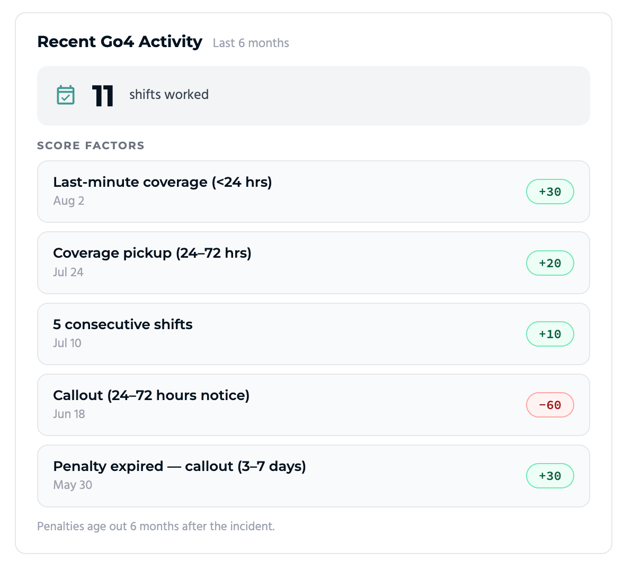
Want to understand why an Athletic Trainer has their current score? Review their Recent Go4 Activity.
This section shows qualifying Reliability Score activity from the last six months and the points associated with each action.
For example, you may see activity such as:
-
Last-Minute Coverage (<24 hrs)
An Athletic Trainer helped fill an urgent coverage need. -
Coverage Pickup (24–72 hrs)
An Athletic Trainer accepted coverage within a shorter lead time. -
Consecutive Shift Milestones
An Athletic Trainer successfully completed a series of shifts without a callout or no-show. -
Callouts
An Athletic Trainer called out of a confirmed commitment, with the amount of notice provided helping you understand the circumstances. -
Expired Penalties
When a negative reliability event reaches six months, its penalty expires and those points are restored to the Athletic Trainer's score.
This makes the Reliability Score much more transparent—you can see the behaviors contributing to the score instead of only seeing the final number.
Understanding Lifetime Totals
The profile also provides lifetime marketplace activity for additional context.
You'll see:
-
Shifts Worked
The total number of shifts the Athletic Trainer has worked through Go4, including how many of those shifts were completed specifically with your organization. -
Callouts
The Athletic Trainer's lifetime number of callouts, including how many occurred with your organization.
You'll also have additional visibility into callout behavior based on the amount of notice provided. -
No-Shows
The Athletic Trainer's lifetime number of no-shows, including how many occurred specifically with your organization.
Lifetime Totals Provide Context
Lifetime callouts and no-shows may remain visible even after they stop impacting the Athletic Trainer's Reliability Score. Use Recent Go4 Activity to better understand the behavior currently influencing their score.
Previous Experience with Your Organization
Go4 also highlights your organization's direct experience with an Athletic Trainer.
In addition to seeing how many shifts they've previously worked for you, you may see your organization's previous "Would I Hire Again?" feedback.
This can provide helpful context when reviewing an Athletic Trainer you've worked with before.
For example, an Athletic Trainer may have worked dozens of shifts across Go4, but knowing they've already successfully completed several shifts for your organization may be particularly relevant to your hiring decision.
Reviewing Athletic Trainer Experience
Reliability tells you how an Athletic Trainer has participated in the marketplace. Experience tells you what they've done professionally.
The Experience section provides visibility into:
- Sports worked
- Number of shifts by sport
- Settings worked
- Number of shifts by setting
- First year certified
- How long they've been on Go4
- Number of Go4 organizations they've worked with
This can help you identify Athletic Trainers whose experience aligns with the type of coverage you're hiring for.
Consider the Full Profile
A highly experienced Athletic Trainer may bring different value than someone newer to the marketplace. Reliability and experience should be considered together—not in isolation.
Reviewing Verified Credentials
An Athletic Trainer's profile provides visibility into both their Go4-verified core credentials and any additional credentials they've chosen to add to their profile.
Go4-Verified Credentials
Before an Athletic Trainer can work through the Go4 marketplace, Go4's Verification Team reviews the three core credentials required for their account:
- BOC Certification
- State Licensure, where required
- Professional Liability Insurance (PLI)
Go4 verifies these credentials and monitors applicable expiration dates to help ensure Athletic Trainers remain eligible to work through the marketplace.
Additional Athletic Trainer Credentials
You may also see additional credentials on an Athletic Trainer's profile, such as a background check, CPR/AED certification, concussion training, additional state licenses, or other professional certifications.
These are added by the Athletic Trainer to provide greater visibility into their qualifications and help demonstrate how they align with additional requirements or expectations they may encounter across the marketplace.
What's Verified by Go4?
Go4's Verification Team verifies an Athletic Trainer's BOC Certification, required State Licensure, and Professional Liability Insurance. Additional credentials displayed on an Athletic Trainer's profile are provided by the Athletic Trainer and should not be interpreted as having undergone the same Go4 verification process unless otherwise indicated.
Making Your Hiring Decision
All of this information is intended to give you greater visibility—not make the decision for you.
Before accepting or declining an applicant, consider the Athletic Trainer's:
- Reliability Score
- Reliability trend
- Recent Go4 Activity
- Lifetime shifts worked
- Previous shifts with your organization
- Callout and no-show history
- Sports and setting experience
- Verified credentials
- Previous experience with your organization
There may be circumstances where an Athletic Trainer has historical negative activity but has demonstrated consistent reliability for months since the incident. That's exactly why Go4 provides both historical context and recent behavior.
You Make the Final Decision
Go4 provides the information and transparency to help you evaluate applicants. Your organization ultimately decides which Athletic Trainer is the best fit for your coverage needs.
FAQs
What is the Go4 Reliability Score?
The Reliability Score provides insight into an Athletic Trainer's recent reliability and participation within the Go4 marketplace.
Scores are measured against a perfect score of 1,000 and can increase or decrease based on qualifying positive and negative marketplace activity.
The score is intended to provide additional context when evaluating applicants and should be considered alongside an Athletic Trainer's experience, credentials, work history, and Recent Go4 Activity.
What score does a new Athletic Trainer start with?
Every new Athletic Trainer begins with a Reliability Score of 750.
A starting score of 750 does not indicate negative activity. It provides new Athletic Trainers with a fair starting point before they've had the opportunity to establish a work history and build their Reliability Score through activity on Go4.
Can an Athletic Trainer's Reliability Score go up and down?
Yes. An Athletic Trainer can gain points through qualifying positive marketplace behaviors and lose points following qualifying reliability events, such as callouts or no-shows.
This allows the score to evolve alongside the Athletic Trainer's recent behavior rather than serving only as a record of negative activity.
Did Athletic Trainer Reliability Scores start on September 1?
No. Athletic Trainers have had visibility into the updated Reliability Score and scoring system since July 2026.
When Reliability Scores become visible to Job Posters on September 1, the score you see will already reflect qualifying Athletic Trainer activity from the previous three months. Going forward, qualifying activity will continue to contribute to the score within the rolling six-month scoring window.
How can Athletic Trainers earn positive Reliability Score points?
Athletic Trainers can earn points through behaviors designed to strengthen reliability across the marketplace. This can include reaching consecutive shift milestones and picking up coverage with shorter notice.
These opportunities were intentionally designed around feedback we've received from Job Posters. For example, when coverage remains open or an Athletic Trainer calls out, incentivizing other Athletic Trainers to pick up that coverage can help organizations fill important gaps while allowing the Athletic Trainer to earn additional income and strengthen their Reliability Score.
What is a shift streak?
A shift streak represents consecutive shifts successfully worked without a qualifying reliability incident interrupting the streak.
As Athletic Trainers reach certain streak milestones, they can earn additional Reliability Score points for consistently honoring their commitments.
How far back does the Reliability Score consider negative activity?
Negative Reliability Score activity impacts an Athletic Trainer's score for six months from the date of the incident.
After six months, the associated penalty expires and no longer negatively impacts their current score. This allows the score to better represent an Athletic Trainer's recent behavior rather than continuing to penalize them for an incident that may have happened years ago.
Why can I still see older callouts or no-shows?
Go4 displays Lifetime Totals to provide additional transparency and historical context.
An older callout or no-show may still appear within an Athletic Trainer's lifetime history even after it stops negatively impacting their current Reliability Score.
Think of the two sections differently: Lifetime Totals provide historical context, while Recent Go4 Activity helps explain the behavior currently influencing the Athletic Trainer's score.
What does the Reliability Score graph show?
The graph shows how an Athletic Trainer's Reliability Score has changed over time.
This gives you additional context into whether their reliability has been improving, declining, or remaining relatively consistent instead of evaluating them based solely on their current score.
What is Recent Go4 Activity?
Recent Go4 Activity provides greater transparency into the qualifying behaviors behind an Athletic Trainer's Reliability Score.
You'll be able to see recent positive and negative score factors, when they occurred, and how many points were added or deducted.
This may include callouts, shorter-notice coverage pickups, consecutive shift milestones, or the expiration of previous penalties.
What does "with you" mean under Lifetime Totals?
When you see "with you" beneath an Athletic Trainer's lifetime totals, it represents how much of that activity occurred specifically with your organization.
For example, if an Athletic Trainer has worked 34 lifetime Go4 shifts and you see "6 with you," that means six of those shifts were worked for your organization.
You'll also see organization-specific information for callouts and no-shows where applicable.
Can I see how much notice an Athletic Trainer provided before a callout?
Yes. The updated profile provides additional context around callouts, including the amount of notice provided. This can help you better understand an Athletic Trainer's historical reliability rather than evaluating all callouts the same way.
Can I see whether an Athletic Trainer has worked with my organization before?
Yes.The profile shows both an Athletic Trainer's lifetime shifts worked through Go4 and how many of those shifts were worked specifically with your organization.
Where available, you may also see your organization's previous "Would I Hire Again?" feedback for that Athletic Trainer.
What experience information can I review?
The Experience section provides additional insight into an Athletic Trainer's work through Go4, including sports worked, settings worked, first year certified, how long they've been on Go4, and the number of Go4 organizations they've worked with.
This can help you determine whether an applicant's previous experience aligns with your specific coverage needs.
Which Athletic Trainer credentials does Go4 verify?
Go4's Verification Team verifies the three core credentials required for an Athletic Trainer to work through the marketplace:
-
BOC Certification
-
State Licensure, where required
-
Professional Liability Insurance (PLI)
These are the core credentials Go4 reviews as part of the Athletic Trainer verification process.
What are the additional credentials shown on an Athletic Trainer's profile?
Athletic Trainers can add additional credentials to their profiles to provide greater visibility into their qualifications and align with additional requirements or expectations they encounter across the marketplace.
These may include items such as background checks, CPR/AED certifications, concussion training, additional state licenses, or other professional certifications.
These additional credentials are provided by the Athletic Trainer and should not be interpreted as having undergone the same Go4 verification process as BOC Certification, required State Licensure, and PLI unless otherwise indicated.
Should I make my hiring decision based only on the Reliability Score?
No. The Reliability Score is intended to provide additional context, not make the hiring decision for you.
We recommend considering the Athletic Trainer's current score, score trend, Recent Go4 Activity, lifetime work history, previous experience with your organization, sports and setting experience, and credentials when evaluating an applicant.
What if an Athletic Trainer believes a callout or no-show is incorrect?
Athletic Trainers have the ability to appeal qualifying Reliability Score activity when they believe circumstances warrant additional review.
Go4 reviews submitted appeals and may adjust Reliability Score activity when appropriate.
Why did Go4 change the Reliability Score?
We wanted the Reliability Score to provide Job Posters with more transparency while creating a fairer way to evaluate Athletic Trainers.
Instead of relying heavily on lifetime negative behavior, the updated experience provides visibility into the behaviors behind the score, places greater emphasis on recent activity, and gives Athletic Trainers opportunities to build their score through positive behaviors that benefit the marketplace.
The result is intended to give Job Posters better information when hiring while allowing Athletic Trainers to be evaluated based on how they're showing up in the marketplace today—not solely on something that may have happened years ago.