
Reliability Score Update: Effective June 1, 2026
Historically, Go4 measured reliability using a percentage-based score that primarily reflected an Athletic Trainer's record of completed shifts and callouts.
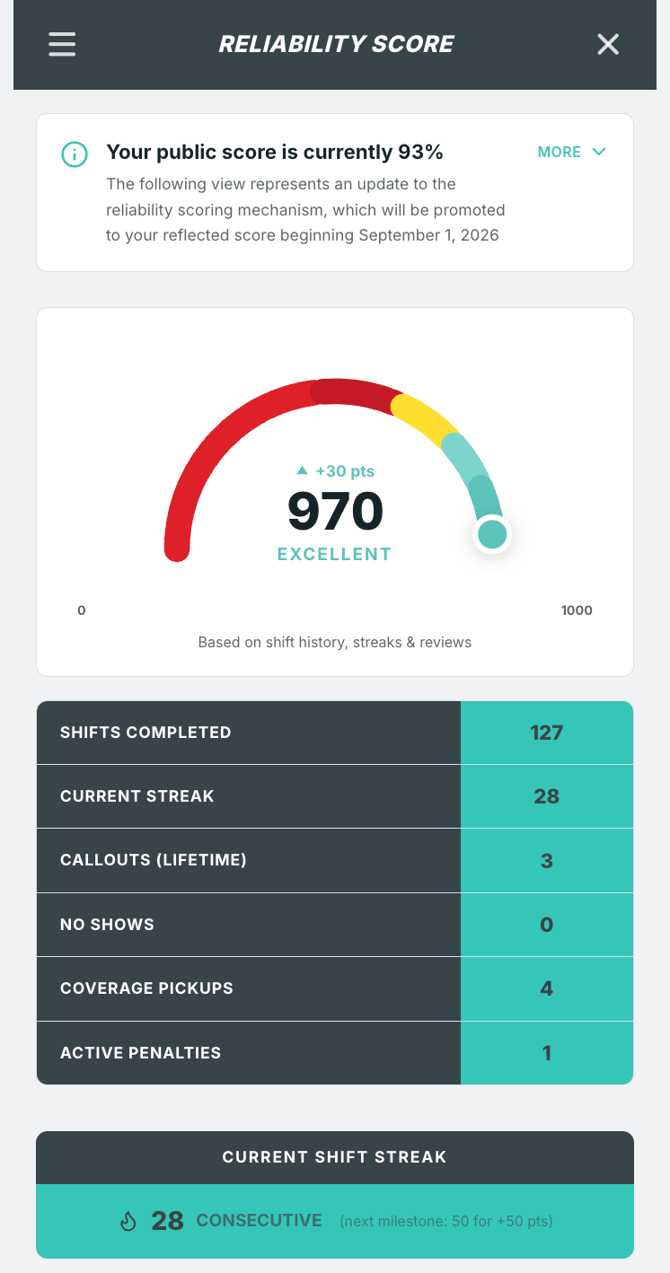
Beginning June 1, 2026, Go4 is introducing a new Reliability Score system that takes a more comprehensive approach by considering factors such as completed shifts, consistency, coverage pickups, callouts, and no-shows.
During the transition period (June 1 – August 31, 2026), Athletic Trainers will be able to view a preview of their new Reliability Score within the Go4 app. Your current public reliability percentage will remain unchanged during this time.
Beginning September 1, 2026, the new Reliability Score will become your official reliability rating on Go4, which will be made public to Job Posters.
The new system is designed to:
- Better reflect the real-world impact of reliability-related behaviors
- Reward consistent participation and coverage support
- Provide clear opportunities to recover from past mistakes
- Increase transparency around how reliability is measured
Want to learn more? Read about it on our blog.
What is a Reliability Score?
Your Reliability Score is a measure of how dependably you fulfill your commitments on Go4.
The score is based on a combination of positive and negative actions, including:
- Completed shifts
- Consecutive shift streaks
- Coverage pickups
- Callouts
- No-shows
Beginning September 1, 2026, Reliability Scores will be displayed on a 0–1000 point scale.
What is a Callout?
A callout occurs when an Athletic Trainer withdraws from a confirmed assignment after committing to work the shift.
Callouts are categorized based on how much notice is provided before the shift begins.
| Callout Type | Timing Before Shift |
|---|---|
| Early Callout | 3–7 days |
| Late Callout | 24–72 hours |
| Last-Minute Callout | Less than 24 hours |
We understand that unexpected situations can arise and that emergencies happen. When a callout is necessary, providing as much notice as possible helps organizations secure replacement coverage and minimizes disruption to athletes and event operations. Because finding replacement coverage becomes more difficult as a shift approaches, callouts made closer to the shift start time have a greater impact on your Reliability Score.
How to Submit a Callout
If you are unable to work a confirmed shift:
- Open the Go4 app
- Navigate to your dashboard and click into your MY JOBS section
- Select CALLOUT on the shift you're unable to work
- SHARE the job with any Athletic Trainer's in the area to help fill it
Submitting a callout as soon as possible helps organizations identify replacement coverage when available and allows them to make informed decisions if coverage cannot be secured.
What Happens After I Submit a Callout?
- The organization will be notified that you are no longer available to work the shift previously confirmed.
- Your Reliability Score may be impacted based on how much notice is provided.
- Once a callout is submitted, Go4 may notify Athletic Trainers in the surrounding area about the newly available shift to help identify replacement coverage. While we will make reasonable efforts to assist, replacement coverage cannot be guaranteed.
What is a No-Show?
A no-show occurs when an Athletic Trainer fails to attend a confirmed shift and does not notify Go4 by utilizing the callout feature in the Go4 app prior to the shift start time.
No-shows create significant disruption for organizations, athletes, and event operations because there is little or no opportunity to secure replacement coverage. In many cases, organizations are left waiting for coverage that will not arrive or must proceed without an Athletic Trainer on-site. As a result, no-shows carry the largest Reliability Score penalty.
Reliability plays an important role in building trust with organizations. If you are unable to work a confirmed shift, we encourage you to submit a callout through the Go4 app as soon as possible. Providing advance notice gives organizations the opportunity to secure replacement coverage when possible, plan accordingly if coverage cannot be found, and helps create a positive experience for everyone involved.
How the Reliability Score Works
The Reliability Score is a dynamic, point-based system designed to reflect your reliability as an Athletic Trainer on Go4. The score updates based on your activity and is intended to reward consistent participation while accounting for behaviors that may impact organizations, athletes, and event operations.
Your score can increase through positive actions such as:
- Completing shifts
- Building consecutive shift streaks
- Picking up coverage opportunities
Your score can decrease when reliability-related incidents occur, such as:
- Callouts
- No-shows
Scores range from:
- Minimum: 0
- Maximum: 1000
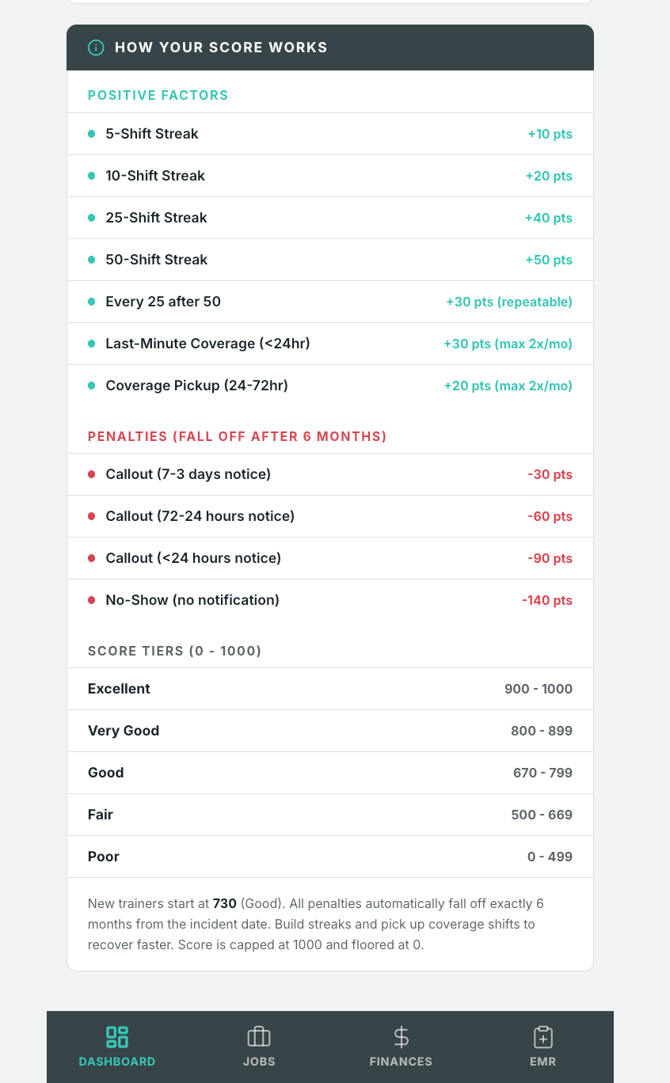
New Athletic Trainers start with a score of 730.
Positive Factors
The following actions can improve your Reliability Score:
Shift Streaks
A shift streak is the number of consecutive shifts completed without a callout or no-show.
| Milestone | Score Impact |
| 5 Consecutive Shifts | +10 points |
| 10 Consecutive Shifts | +20 points |
| 25 Consecutive Shifts | +40 points |
| 50 Consecutive Shifts | +50 points |
| Every Additional 25 Shifts After 50 | +30 points |
Coverage Pickups
When another Athletic Trainer can no longer work a shift, stepping in to help cover that shift may improve your Reliability Score.
| Coverage Type | Score Impact |
| Coverage Pickup (24–72 Hours) | +20 points |
| Last-Minute Coverage (<24 Hours) | +30 points |
Negative Factors
The following actions reduce your Reliability Score:
| Event | Score Impact |
| Callout (3–7 Days) | -30 points |
| Callout (24–72 Hours) | -60 points |
| Callout (<24 Hours) | -90 points |
| No-Show | -140 points |
Penalties are applied after the incident occurs.
Reliability Score Tiers
Your Reliability Score falls into one of the following categories:
| Tier | Score Range |
| Excellent | 900–1000 |
| Very Good | 800–899 |
| Good | 670–799 |
| Fair | 500–669 |
| Poor | Below 500 |
These tiers provide a simple way to understand your current reliability standing within the Go4 marketplace. As your Reliability Score changes over time, your tier may also change based on your recent activity and participation. Consistently completing shifts, maintaining streaks, and avoiding callouts and no-shows can help improve your Reliability Score over time.
Penalty Expiration
Reliability-related penalties do not remain on your score permanently.
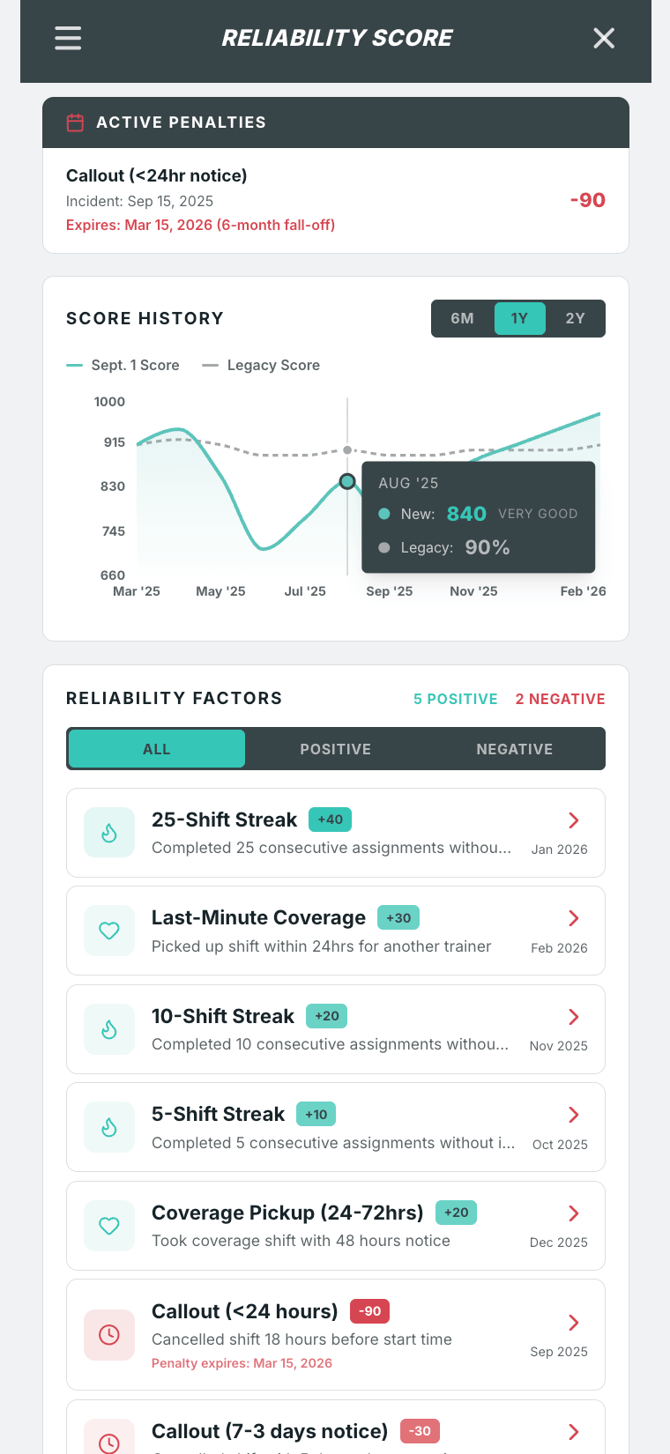
All callout and no-show penalties automatically expire six months (180 days) after the incident date.
Once a penalty expires, it is removed from your Reliability Score calculation.
This allows Athletic Trainers to recover from past mistakes through consistent participation and reliable performance.
FAQs
Why do I see a new Reliability Score in the app?
Beginning June 1, 2026, Go4 is displaying a preview of the upcoming Reliability Score system. This allows Athletic Trainers to view and track their Reliability Score before it becomes the official reliability rating on September 1, 2026.
Is my current reliability percentage changing right now?
No. Your current public reliability percentage will remain unchanged through August 31, 2026.
When does the new Reliability Score become official?
The new Reliability Score will become your official reliability rating on September 1, 2026.
Why is Go4 changing the Reliability Score system?
The new Reliability Score system is designed to better reflect the real-world impact of reliability-related behaviors, reward consistent participation, provide opportunities for recovery, and increase transparency around how reliability is measured.
What is a good Reliability Score?
Reliability Scores are grouped into the following tiers:
-
Excellent: 900–1000
-
Very Good: 800–899
-
Good: 670–799
-
Fair: 500–669
-
Poor: Below 500
How can I improve my Reliability Score?
You can improve your Reliability Score by:
-
Completing shifts consistently
-
Building consecutive shift streaks
-
Picking up coverage opportunities
-
Avoiding callouts and no-shows
How often is my Reliability Score updated?
Your Reliability Score is updated as qualifying reliability events occur, such as completed shifts, coverage pickups, callouts, and no-shows.
Do completed shifts improve my Reliability Score?
Completed shifts contribute toward shift streaks, which can earn Reliability Score bonuses when milestone streaks are achieved.
What is a shift streak?
A shift streak is a series of consecutive completed shifts without a callout, no-show, or other qualifying reliability interruption.
What happens if my shift streak is interrupted?
Any callout or no-show will reset your current streak and require you to begin building a new streak.
What is a coverage pickup?
A coverage pickup occurs when an Athletic Trainer accepts and confirms a shift that needs replacement coverage within a designated timeframe before the shift begins.
Coverage pickups can positively impact your Reliability Score.
What is a callout?
A callout occurs when an Athletic Trainer withdraws from a confirmed shift after committing to work the shift.
Why do later callouts have a larger impact on my score?
The closer a shift is to its start time, the more difficult it becomes for organizations to secure replacement coverage. As a result, later callouts have a greater impact on your Reliability Score than those made with more advance notice.
What should I do if I cannot work a confirmed shift?
Submit a callout through the Go4 app as soon as possible. Providing advance notice gives organizations the opportunity to secure replacement coverage when possible and allows them to plan accordingly if coverage cannot be found.
What happens after I submit a callout?
Once a callout is submitted:
-
The organization will be notified that you are no longer available.
-
Your Reliability Score may be impacted based on how much notice is provided.
-
Go4 may notify other Athletic Trainers about the open shift to help identify replacement coverage. While reasonable efforts may be made to assist, replacement coverage cannot be guaranteed.
What is a no-show?
A no-show occurs when an Athletic Trainer fails to attend a confirmed shift and does not notify Go4 by utilizing the callout feature in the Go4 app prior to the shift start time.
Why do no-shows have the largest penalty?
No-shows create significant disruption for organizations, athletes, and event operations because there is little or no opportunity to secure replacement coverage. In many cases, organizations are left waiting for coverage that will not arrive or must proceed without an Athletic Trainer on-site.
Do callouts and no-shows remain on my score forever?
No. Reliability-related penalties automatically expire after six months (180 days).
Once a penalty expires, it is removed from your Reliability Score calculation.
Can my Reliability Score recover after a callout or no-show?
Yes. The Reliability Score is designed to reflect recent behavior and provide opportunities for recovery through consistent participation, shift completion, and coverage support.
What if I believe a callout or no-show was recorded incorrectly?
If you believe a callout or no-show was recorded in error, please contact the Go4 Support team at support@go4.io within 72 hours of the related event to be eligible for review.
Our team will evaluate requests on a case-by-case basis. Supporting documentation may be requested depending on the circumstances.
Can my Reliability Score go below zero?
No. Reliability Scores have a minimum value of 0 and a maximum value of 1000.
Do new Athletic Trainers start at zero?
No. New Athletic Trainers begin with a starting Reliability Score of 730.
Will my score ever exceed 1000?
No. Reliability Scores are capped at a maximum value of 1000.
Can emergencies happen without affecting my score?
We understand that unexpected situations can arise. Reliability events are recorded based on marketplace activity and timing; however, if you believe a callout or no-show was recorded incorrectly, please contact Go4 Support for review at support@go4.io.
Where can I view my Reliability Score?
Your Reliability Score can be viewed directly within the Go4 app.
Will I be able to see why my score changed?
Yes. The goal of the system is transparency.
Users will be able to see:
-
active penalties
-
streak progress
-
milestone rewards
-
expiration timing for historical penalties
This helps make score changes understandable and predictable.
Will my Reliability Score change if I am inactive?
Possibly. Reliability Scores are designed to reflect recent activity and reliability-related events. As older events reach their expiration date and are removed from the score calculation, your Reliability Score may change even if you are not actively working shifts on Go4.
Will older historical incidents still count after launch?
Historical incidents will transition out of the system on an accelerated schedule during rollout. Only impacts made after Jun 1, 2026 will carry a full 6-month expiration period.
The goal is to ensure:
-
older events phase out first
-
all pre-launch historical penalties fully expire during the first few months of the new system and before the new score is promoted to the primary score.
-
long-term scores reflect behavior under the updated system framework
This creates a fair transition into the new model.
What happens if I have very little shift history?
The new system is designed to reduce extreme volatility for newer or lower-activity users.
Instead of large swings from a small number of events, the score uses:
-
stable starting values
-
incremental adjustments
-
streak-based progression
This creates a more balanced experience for newer trainers.
Is this system permanent, or will it evolve?
The system is designed to evolve over time as marketplace behavior and operational needs are better understood.
Future refinements may include:
-
different expiration durations by incident type
-
additional positive behavior incentives
-
improved transparency features
-
refined weighting models
Any future adjustments will continue to prioritize fairness, accountability, and recoverability.
What is the overall philosophy behind the new system?
The system is built around two core ideas:
-
Reliability matters.
-
Recovery should always be possible.
The goal is not to permanently punish users for isolated incidents, but to encourage consistent, dependable participation while creating a clear path back from setbacks.